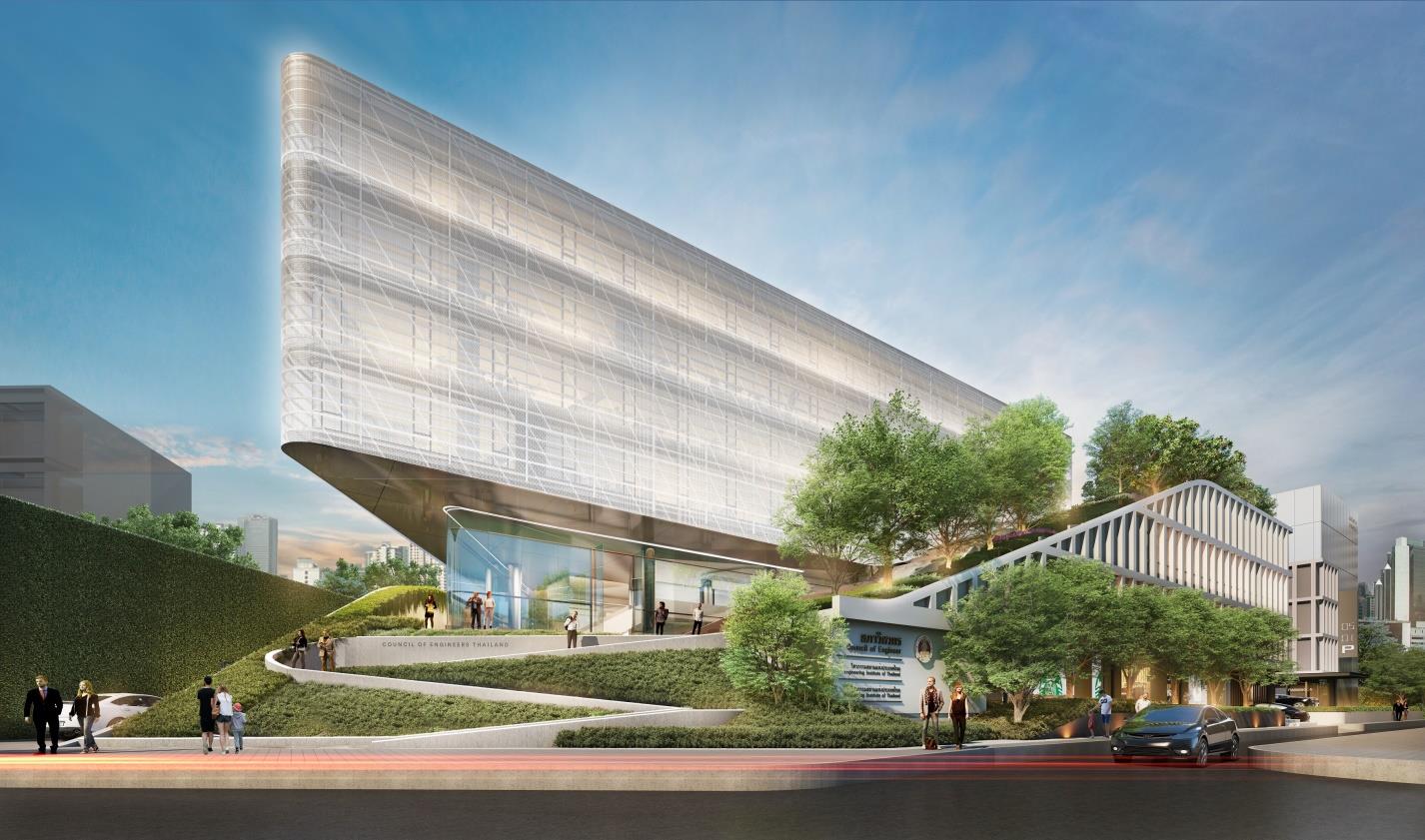
The "Council of Engineers Building" is a newly constructed 7-floor office building located on Ladprao Road at the entrance of Soi 54. The building has a total usable area of approximately 9,000 square meters, and is served by a separate automatic car-parking structure accommodating 78 vehicles. The Council of Engineers Building uses engineering principles to create a healthy indoor environment for occupants, protecting them from external pollutants such as PM2.5 dust and the urban heat island effect. The HVAC system plays a central role in preventing and resolving these issues under the concept of a 24/7 public and office building — where the air conditioning system never shuts down for the lifetime of the building. The HVAC design also follows an energy-conservation approach suited to a building located in the hot and humid tropical region near the equator.
"อาคารที่ทำการสภาวิศวกร" เป็นอาคารที่ก่อสร้างใหม่บนถนนลาดพร้าวบริเวณปากซอย 54 ซึ่งเป็นอาคาร 7 ชั้น มีพื้นที่ใช้สอยประมาณ 9,000 ตารางเมตร และมีอาคารจอดรถอัตโนมัติแยกจากอาคารหลักจำนวน 78 คัน อาคารที่ทำการสภาวิศวกรจะเป็นอาคารที่ใช้ทางวิศวกรรม สร้างสภาพแวดล้อมให้กับผู้เข้าใช้อาคาร ให้มีสุขภาพดีปกป้องมลพิษต่างๆ จากภายนอกไม่ว่าจะเป็นฝุ่น PM2.5 หรือความร้อนจากปรากฏการณ์เกาะความร้อน (Heat island effect) ซึ่งระบบปรับอากาศระบายอากาศดีในอาคารที่ทำการสภาวิศวกรมีบทบาทสำคัญที่จะมีหน้าที่ป้องกันและแก้ไขปัญหาเหล่านี้ภายในใต้แนวความคิดอาคารสาธารณะและสำนักงาน 24/7 (24 ชม 7 วัน) ซึ่งระบบปรับอากาศจะไม่มีการหยุดระบบตลอดอายุการใช้งานอาคาร รวมถึงระบบปรับอากาศในอาคารจะเป็นแนวทางในการอนุรักษ์พลังงาน ที่เหมาะสมสำหรับ อาคารที่ตั้งในภูมิภาคร้อนชื้นแถบศูนย์สูตร
ntroduction
Introduction บทนำWhen designing public buildings or office buildings with large numbers of occupants, one factor that has always been considered is efficient energy use. The HVAC system — which accounts for over 70% of a building's total energy consumption — is always at the center of that discussion. Energy-saving devices have been adopted in many forms, sometimes as a transfer of technology and knowledge from Western countries. However, due to differing climates, some approaches may not be suitable for the hot and humid tropical climate near the equator. Furthermore, external pollution problems that affect buildings and their occupants — such as PM2.5 dust, the COVID-19 pandemic, and new threats that will inevitably arise in the future — must all be considered in building design. The design must be adaptable to accommodate new challenges. The concept of creating a healthy indoor environment (Well-Being) for building users is increasingly discussed, and the question "Are we in a safe place?" will grow louder from occupants who spend many hours working, conducting activities, trading, or living in air-conditioned spaces.
The HVAC design for the Council of Engineers Building attempts to be appropriate for Thailand's tropical climate. It is well known that complying with standard design guidelines requires bringing in fresh outside air — air that carries both heat and high humidity — to be conditioned as fresh air supply into the building. This consumes a great deal of energy to reduce both temperature and humidity, far more than in Western countries due to the different climate. Furthermore, creating a high-quality indoor air environment requires supplying at least 30% more fresh air than standard design specifications — both for well-being reasons and energy conservation. In this context, a high-efficiency cooling system must be selected. The Council of Engineers Building chose a water-cooled chiller plant system, which can achieve very favorable energy performance figures (kW/TON).
On the air-side, the design separates the fresh air supply using a Dedicated Outdoor Air System (DOAS). This system delivers fresh air at 30% above standard requirements and includes supplementary equipment to reduce energy consumption. The DOAS is also a critical component for PM2.5 protection and is the primary device responsible for maintaining the building as a 24/7 environment.
Something familiar in most air conditioning systems that will not be found in this Council of Engineers Building: supply air ducts and return air ducts. All fan coil units throughout the building will not use ductwork — eliminating dust accumulation and mold growth inside ducts. Only the fresh air supply ducts from the DOAS, carrying conditioned dry air, will be installed.
การออกแบบอาคารสาธารณะหรืออาคารสำนักงานที่มีผู้เข้าใช้อาคารจำนวนมากปัจจัยที่คำนึงถึงตั้งแต่อดีต คือการใช้พลังงานอย่างคุ้มค่า และระบบปรับอากาศระบายอากาศที่ใช้พลังงานกว่า 70% ของอาคารจะเป็นสิ่งที่ต้องถูกกล่าวถึงเสมอ อุปกรณ์ประหยัดพลังงานถูกนำมาใช้ในหลายรูปแบบซึ่งในบางกรณีอาจจะเป็นการถ่ายทอดเทคโนโลยีและความรู้จากตะวันตก ซึ่งภูมิอากาศที่แตกต่างกัน บางครั้งจึงอาจจะไม่เหมาะสมในภูมิอากาศร้อนชื้นแถบศูนย์สูตร (Tropical Climates) อีกทั้งในปัจจุบันปัญหาเรื่องมลพิษภายนอกที่กระทบต่อตัวอาคารเพราะผู้ใช้ไม่ว่าจะเป็นปัญหาฝุ่น PM 2.5 หรือจะเป็นการระบาดของไวรัสโควิท 19 (COVID-19) และในอนาคตจะต้องมีปัญหาใหม่ ที่จะเกิดขึ้น การออกแบบอาคารจึงต้องคำนึงถึงและสามารถปรับเพื่อรองรับปัญหาใหม่ๆ ได้ด้วย ซึ่งแนวทางสร้างสภาวะสิ่งแวดล้อมที่ให้ผู้ใช้อาคารมีสุขภาพดี (Well being) ถูกพูดถึงมากขึ้น และต่อไปการเข้าใช้อาคารไม่ว่าจะเป็นการทำงาน ทำกิจกรรม ค้าขาย หรืออยู่อาศัยในอาคารภายใต้ระบบปรับอากาศในเวลานานหลายชั่วโมง คำถามมีอยู่ว่า "เรากำลังอยู่ในที่ปลอดภัยหรือไม่" จากผู้ใช้อาคารจะดังขึ้นเรื่อยๆ
การออกแบบระบบปรับอากาศระบายอากาศในที่ทำการสภาวิศวกรพยายามจะออกแบบให้เหมาะสมกับภูมิอากาศในประเทศไทยที่เป็น (Tropical Climate) ซึ่งเป็นที่ทราบกันดีว่าเมื่อปฏิบัติตามมาตรฐานการออกแบบจะต้องการนำอากาศบริสุทธิ์ที่มีทั้งความร้อนและความร้อนสูง มาใช้เป็นอากาศบริสุทธิ์เติมเข้าอาคาร โดยจะต้องใช้พลังงานเพื่อลดอุณหภูมิและความชื้นมาก ซึ่งปริมาณการใช้พลังงานจะมากกว่าประเทศตะวันตกหลายเท่าตัวเนื่องจากสภาพอากาศที่แต่ตางกัน อีกทั้งการสร้างสภาวะอากาศที่ดีในอาคารยังต้องการปริมาณอากาศบริสุทธิ์เพิ่มมากกว่ามาตรฐานออกแบบปกติอย่างน้อย 30% ทั้งเหตุผลการสร้างสุขสภาวะที่ดี (Well being) และการอนุรักษ์พลังงาน ระบบทำความเย็นประสิทธิภาพสูงจะต้องถูกเลือกใช้ในกรณีนี้ อาคารที่ทำการสภาวิศวกรเลือกใช้ระบบทำน้ำเย็นแบบระบายความร้อนด้วยน้ำ (CHILLER WATER COOL SYSTEM) ซึ่งสามารถทำค่าพลังงานต่อตันความเย็นได้ดีมาก (KW/TON)
ในด้านของระบบเติมอากาศบริสุทธิ์ออกแบบให้มีการแยกเครื่องเติมอากาศบริสุทธิ์ (DEDICATED OUTSIDE AIR UNIT) โดยเฉพาะและมีกำลังจ่ายอากาศบริสุทธิ์มากกว่ามาตรฐานกำหนด 30% ซึ่งจะต้องมีอุปกรณ์ช่วยเพื่อลดการใช้พลังงานและ (DOAS) เครื่องเติมอากาศบริสุทธิ์ยังเป็นอุปกรณ์สำคัญในการป้องกัน PM 2.5 และเป็นอุปกรณ์หลักในการสร้างสภาวะอากาศภายในอาคารให้เป็นอาคาร 24/7
สิ่งที่คุ้นเคยในระบบปรับอากาศที่อาจจะไม่มีในอาคารที่ทำการสภาวิศวกรแห่งนี้คือ ท่อส่งลมเย็น, ท่อลมกลับ เครื่องปรับอากาศน้ำเทน้ำทิ้งหมดในอาคารจะไม่ใช้ท่อลมเพื่อลดปัญหาการสะสมของฝุ่นและเชื้อราในท่อลม คงจะมีท่อเติมอากาศบริสุทธิ์ที่มีการปรับสภาวะให้อากาศแห้งผ่านท่อเท่านั้น
ual-Temp Dual-Loop
Chiller Plant System
Dual-Temperature Dual-Loop Chiller Plant
ระบบผลิตน้ำเย็นแบบสองอุณหภูมิสองวงจร
Because HVAC energy consumption represents 70% of total building energy, a high-efficiency HVAC system must be selected. Even though the Council of Engineers Building has a total floor area of less than 10,000 square meters — and is not an extra-large building — the decision was still made to use a chiller plant with a water-cooled chiller, which delivers superior efficiency.
The selected chillers use the latest compressor technology — oil-free compressors driven by magnetic levitation (MAGNETIC OIL FREE COMPRESSOR).
เนื่องจากความต้องการพลังงานในระบบปรับอากาศและระบายอากาศเป็น 70% ของพลังงานรวมทั้งอาคาร จึงต้องเลือกใช้ระบบปรับอากาศและระบายอากาศที่มีประสิทธิภาพสูงแม้อาคารที่ทำการสภาวิศวกรจะเป็นอาคารที่มีพื้นที่ไม่ถึง 10,000 ตารางเมตร หรือไม่ใช่อาคารใหญ่พิเศษ แต่ยังคงเลือกระบบผลิตน้ำเย็นและใช้เครื่องทำน้ำเย็นแบบระบายความร้อนด้วยน้ำ ซึ่งจะให้ประสิทธิภาพการทำงานที่สูง
เครื่องทำน้ำเย็นที่เลือกใช้เป็นเครื่องทำน้ำเย็นในเทคโนโลยีที่ทันสมัยพัฒนาจากเดิม คอมเพรสเซอร์จะเป็นชนิดใช้น้ำมันขับเคลื่อนด้วยพลังแม่เหล็ก (MAGNETIC OIL FREE COMPRESSOR)
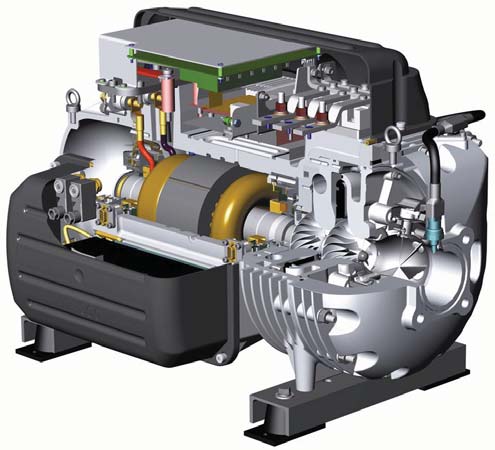
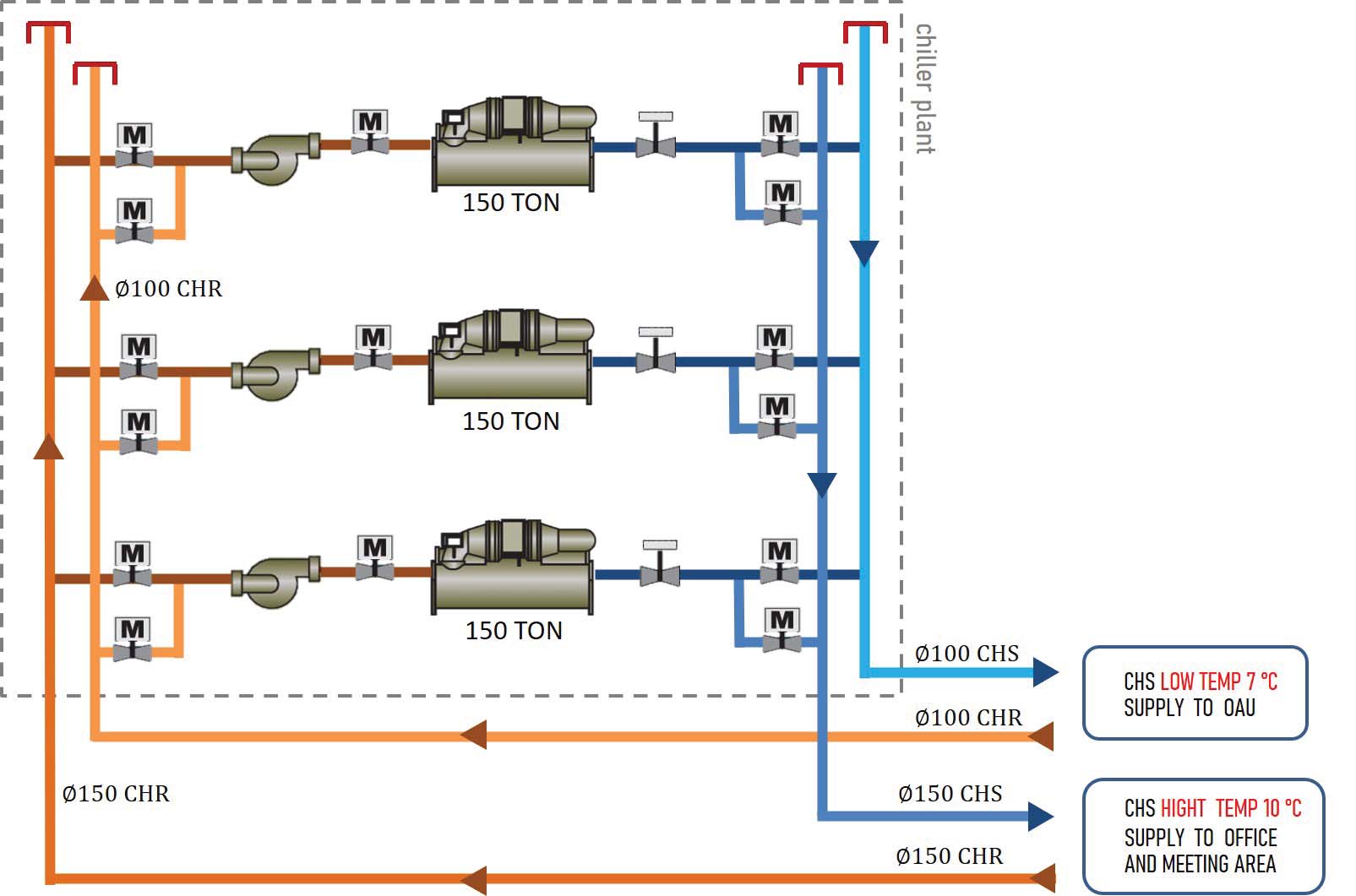
These chillers achieve a satisfactory energy consumption rate below 0.6 kW/TON under Thailand's climate conditions. The total cooling load is approximately 280 tons of refrigeration, and three 150-TON chillers are selected. The chilled water piping circuit and chilled water temperature production are divided into two separate loops. The low-temperature chilled water circuit for the DOAS and the server room is maintained at a constant 7.2°C (45°F), while the high-temperature chilled water circuit for all general office areas varies with outdoor temperature and season between 7.2°C and 10°C (45–50°F).
ซึ่งมีค่าการใช้พลังงาน kw/ton เป็นที่น่าพอใจโดยต่ำกว่า 0.6 kw/ton ตามสภาวะอากาศของประเทศไทยซึ่งจะมีขนาดภาระการทำความเย็นประมาณ 280 ตันความเย็น และเลือกเครื่องทำน้ำเย็นขนาด 150 ตันความเย็น 3 ชุด การออกแบบวงจรท่อน้ำเย็นและการผลิตอุณหภูมิน้ำเย็นจะแยกเป็น 2 วงจร โดยวงจรน้ำเย็นอุณหภูมิต่ำสำหรับเครื่องเติมอากาศบริสุทธิ์และศูนย์คอมพิวเตอร์จะคงที่ 7.2 °C (45°F) และวงจรน้ำเย็นอุณหภูมิสูงสำหรับพื้นที่ทั่วไปทั้งหมดจะแปรผันตามอากาศภายนอกและฤดูกาลที่อุณหภูมิ 7.2 °C - 10 °C (45–50°F)
Low Temp Circuit
For DOAS and Server Room
Constant temperature 7.2°C (45°F)
สำหรับ DOAS และ Server Room
อุณหภูมิคงที่ 7.2°C (45°F)
High Temp Circuit
For general office areas
Variable 7.2–10°C (45–50°F)
สำหรับพื้นที่สำนักงานทั่วไป
แปรผัน 7.2–10°C (45–50°F)
Energy Saving
Saves 10–35% energy by raising the chilled water temperature ประหยัดพลังงานได้ 10–35% จากการปรับอุณหภูมิน้ำเย็นให้สูงขึ้น
The chilled water temperature setpoint is controlled by an automatic control system that processes both indoor and outdoor temperature and humidity data, then sets the target chilled water temperature for the high-temperature chilled water circuit to maximize energy savings. However, this design approach requires selecting larger air conditioning units that can still adequately cool the spaces when supplied with higher-temperature chilled water. For approximately 70% of annual operating hours, the units will receive chilled water at 10°C (50°F).
Dividing the chilled water circuits with different temperatures reduces energy consumption from the chiller plant side. On the air side (AIR SIDE), the DOAS is designed to handle moisture and supply dry fresh air into the building. With the indoor humidity load from people and building activities kept relatively low, the chilled water temperature in the circuit serving the office areas can be raised while still maintaining desired temperature and humidity control.
Raising the chilled water temperature to save energy is a well-established practice in large buildings in Thailand, because doing so directly reduces the compressor workload of the chiller, saving as much as 10–35% energy depending on the degree of temperature rise. However, in a conventional single-loop chilled water system, raising the chilled water temperature improves energy efficiency at the cost of reduced dehumidification performance — causing indoor humidity to rise and sometimes leading to mold problems. To suit the hot and humid tropical climate, the chiller plant is therefore designed as a Dual-Temperature Dual-Loop system (DUAL TEMPERATURE DUAL LOOP Chiller Plant, DTDL).
On the fresh air supply side, the design includes a dedicated fresh air unit (DEDICATED OUTSIDE AIR UNIT) with a supply capacity 30% above the design standard. Supplementary equipment is included to reduce energy consumption. The DOAS unit is also the key device for PM2.5 protection and for maintaining the building as a 24/7 operation.
โดยควบคุมการสั่งอุณหภูมิน้ำเย็นจากระบบควบคุมอัตโนมัติซึ่งจะประมวลผลของอุณหภูมิและความชื้นทั้งภายในอาคารและภายนอกอาคาร จึงจะส่งกำหนดค่าอุณหภูมิน้ำเย็น ส่วนวงจรน้ำเย็นอุณหภูมิสูง เพื่อให้ประหยัดพลังงานสูงสุด แต่การออกแบบเช่นนี้เครื่องปรับอากาศจะต้องเลือกขนาดใหญ่ขึ้น ที่สามารถรองรับน้ำเย็นอุณหภูมิสูง แล้วยังคงทำความเย็นให้กับพื้นที่ได้ ซึ่งแทบจะ 70% ของเวลาทั้งปีจะรับน้ำเย็นที่อุณหภูมิ 10 °C (45–50°F)
การแบ่งวงจรน้ำเย็นและอุณหภูมิที่ต่างกันสามารถให้ลดการใช้พลังงานจากการผลิตน้ำเย็นได้ประกอบกับด้านปรับอากาศ (AIR SIDE) ออกแบบให้มีเครื่องเติมอากาศบริสุทธิ์ (DOAS) เป็นตัวจัดการความชื้นและเติมอากาศบริสุทธิ์ที่แห้งเข้ามาในอาคาร ความชื้นที่เกิดจากคนและปัจจัยในอาคารจะมีไม่สูงมากทำให้เราสามารถยกอุณหภูมิน้ำเย็นในวงจรที่จ่ายพื้นที่สำนักงานได้โดยยังควบคุมอุณหภูมิและความชื้นได้ตามที่ต้องการ
เราจะเห็นการปรับอุณหภูมิน้ำเย็นให้สูงขึ้นเพื่อประหยัดพลังงานในอาคารขนาดใหญ่ของประเทศไทยเสมอเป็นวิธีการที่ทำกันอยู่แล้ว เพราะการปรับอุณหภูมิน้ำเย็นให้สูงขึ้นมีผล ลดการทำงานของคอมเพรสของเครื่องทำน้ำเย็นโดยตรงส่งผลให้สามารถประหยัดพลังงานได้มากถึง 10–35% ขึ้นกับการปรับอุณหภูมิน้ำเย็นที่ปรับให้สูงขึ้น แต่ในระบบทำเย็นปกติที่ใช้กันในประเทศไทยจะเป็นวงจรเดียวอุณหภูมิเดียว ฉะนั้นการปรับอุณหภูมิน้ำเย็นให้สูงขึ้นเพื่อจะประหยัดพลังงาน จะมีผลเสียกับประสิทธิภาพการลดความชื้นของเครื่องปรับอากาศทันทีมีผลให้ความชื้นในอาคารสูงขึ้น จนบางครั้งเกิดปัญหาเชื้อราในอาคารตามมา เพื่อให้เหมาะสมกับภูมิอากาศร้อนชื้นแถบศูนย์สูตร การออกแบบระบบทำน้ำเย็น (CHILLER PLANT) จะเป็นระบบผลิตน้ำเย็นแบบ สองอุณหภูมิน้ำเย็นสองวงจรท่อส่งน้ำเย็น (DUAL TEMPERATURE DUAL LOOP Chiller Plant, DTDL)
ในด้านของระบบเติมอากาศบริสุทธิ์ออกแบบให้มีการแยกเครื่องเติมอากาศบริสุทธิ์ (DEDICATED OUTSIDE AIR UNIT) โดยเฉพาะและมีกำลังจ่ายอากาศบริสุทธิ์มากกว่ามาตรฐานกำหนด 30% ซึ่งจะต้องมีอุปกรณ์ช่วยเพื่อลดการใช้พลังงานและ (DOAS) เครื่องเติมอากาศบริสุทธิ์ยังเป็นอุปกรณ์สำคัญในการป้องกัน PM 2.5 และเป็นอุปกรณ์หลักในการสร้างสภาวะอากาศภายในอาคารให้เป็นอาคาร 24/7
OAS (Dedicated Outdoor Air System)
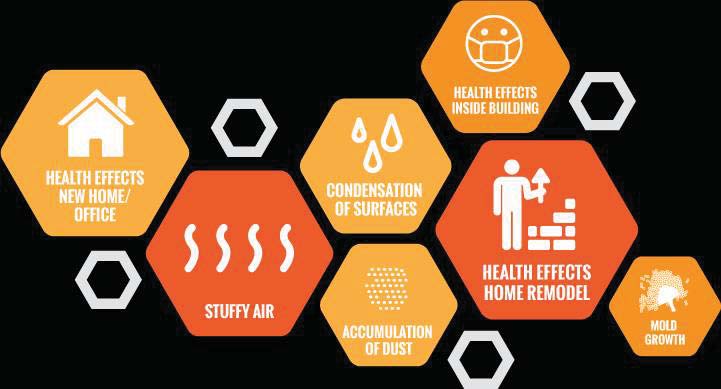
Dedicated Outdoor Air System ระบบเติมอากาศบริสุทธิ์โดยเฉพาะCreating a healthy indoor air environment is increasingly necessary today due to worsening external environmental conditions — including PM2.5 dust pollution that affects every major city and the urban heat island effect, among others.
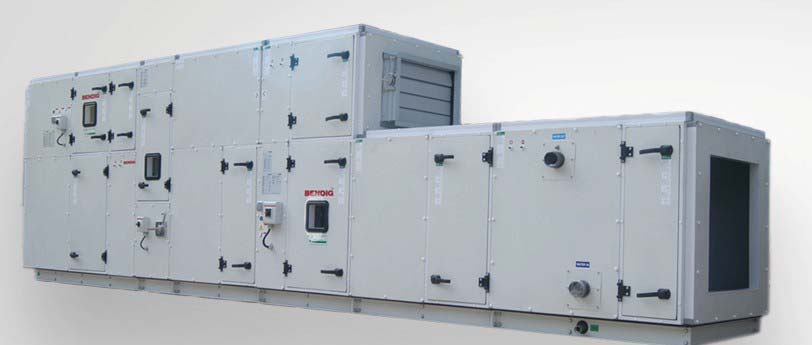
The Council of Engineers Building is designed with a dedicated fresh air supply unit — separate from the air conditioning units — called a DOAS (Dedicated Outdoor Air System). It is installed on the 7th floor of the building and delivers conditioned fresh air directly to individual zones and rooms throughout the building, without routing it through any air conditioning unit. The DOAS removes moisture from the outside air, bringing the moisture content of the fresh air supply below the indoor air moisture level. The result is dry fresh air that can be introduced into the building without causing humidity problems.
การสร้างสภาวะอากาศที่ดีต้องสุขภาพเป็นสิ่งที่จำเป็นมากขึ้นในปัจจุบันเนื่องจากปัญหาจากสภาวะแวดล้อมเป็นพิษมากขึ้นไม่ว่าจะเป็นปัญหาจากฝุ่นควัน PM 2.5 ที่มีทุกเมืองใหญ่ ปรากฏการณ์เกาะความร้อน (ISLAND HEAT) เป็นต้น
ในอาคารที่ทำการสภาวิศวกรออกแบบให้มีการเติมอากาศบริสุทธิ์จากเครื่องเติมอากาศบริสุทธิ์ที่แยกจากเครื่องปรับอากาศที่เรียกว่า DOAS (Dedicated outdoor Air System) ซึ่งจะติดตั้งที่ชั้น 7 ของอาคารและจ่ายอากาศบริสุทธิ์ไปยังจุดต่างๆ ของอาคารโดยเป็นการจ่ายตรงลงไปในพื้นที่หรือห้องที่ต้องการไม่จ่ายเข้าเครื่องปรับอากาศใดใดอีก ซึ่ง DOAS จะทำการรีดน้ำในอากาศบริสุทธิ์ให้มีปริมาณน้ำในอากาศบริสุทธิ์ต่ำกว่าปริมาณน้ำในอากาศของอาคาร เราจะได้อากาศบริสุทธิ์ที่แห้ง เติมเข้าอาคารไม่ก่อปัญหาเรื่องความชื้น
The fresh air supply rate is designed to create a positive indoor air pressure — at a flow rate 30% above ASHRAE 62.1 standards. The DOAS is equipped with MERV 8 and MERV 14 air filters to remove PM2.5 dust before air enters the building. The PM2.5-free, positively pressurized fresh air prevents PM2.5 from infiltrating the building.
While the DOAS might appear to consume high amounts of energy, energy conservation measures are incorporated. A heat pipe is installed to pre-dry the incoming fresh air, preventing mold growth in the ducts. A heat recovery unit is also installed to recapture energy from the exhaust air — which would otherwise be lost — and use it for a first-stage pre-cooling of the incoming fresh air. In high-occupancy rooms such as examination halls and the 300-seat conference room, CO₂ sensors are installed to control the fresh air supply rate as needed, saving energy.
ปริมาณการเติมอากาศบริสุทธิ์เพื่อให้มีการสร้างสภาวะแรงดันอากาศเป็นบวกที่จะให้มีอัตราการเติมอากาศสูงกว่ามาตรฐาน ASHRAE 62.1 เพิ่มเป็นอีก 30% ซึ่งการเกิดแรงดันบวก DOAS จะติดตั้งแผงกรองอากาศ MERV 8 และ MERV 14 เพื่อกรองฝุ่น PM2.5 ก่อนเข้าอาคาร อากาศบริสุทธิ์ที่ไม่มีฝุ่น PM2.5 และช่วยสร้างแรงดันบวกให้กับอาคาร จะเป็นการป้องกันฝุ่น PM 2.5 เข้าสู่อาคาร
ทั้งนี้การ DOAS เหมือนจะต้องใช้พลังงานสูงมาก แต่เมื่อพิจารณาเรื่องการอนุรักษ์พลังงาน จึงติดตั้งอุปกรณ์เพิ่มเติมเช่น HEAT PIPE เพื่อทำให้อากาศบริสุทธิ์แห้งไม่ก่อให้เกิดเชื้อราในท่อและติดตั้ง HEAT RECOVERY เพื่อนำพลังงานสูญเสียที่จะต้องเสียไปจากการระบายอากาศออกกลับมา ทำความเย็นชั้นแรกให้กับอากาศที่จะนำเข้าสู่อาคาร ในห้องที่มีคนใช้อาคารมากมาก เช่นห้องสอบ ห้องประชุมขนาด 300 ที่นั่งจะติดอุปกรณ์จับ ปริมาณก๊าซคาร์บอนไดออกไซด์ควบคุมการจ่ายอากาศบริสุทธิ์ให้เหมาะสมเป็นการประหยัดพลังงาน
uctless Terminal Unit
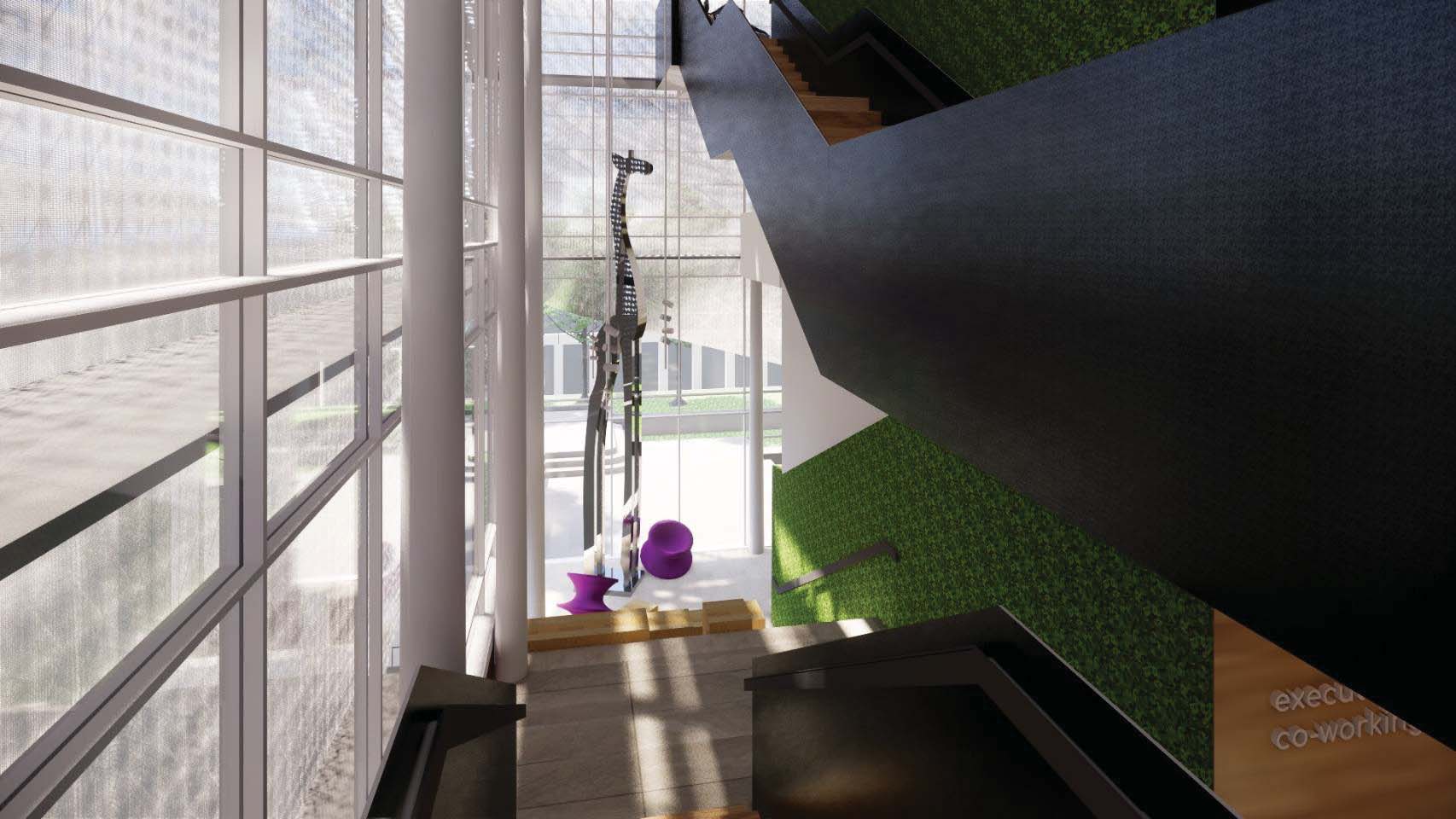
Ductless Terminal Unit System ระบบปรับอากาศแบบไร้ท่อลมIt is common in large commercial office buildings to use large air handling units (AHU) with supply air ductwork. However, this approach typically leads to contamination inside the ducts that is difficult to clean — because the cool air leaving the cooling coil carries humidity of 90–95% RH, which then condenses and accumulates dust and mold as it travels through the supply ducts. To create a healthy indoor air environment, the design instead installs air conditioning units as individual point-cooling devices, with virtually no supply air ductwork throughout the entire building. The air conditioning units used are of the CASSETTE TYPE 4-WAY or 1-WAY type, replacing all ductwork.
เป็นที่พบเห็นทั่วไปสำหรับอาคารสำนักงานอาคารขนาดใหญ่การปรับอากาศจะใช้เครื่องปรับอากาศขนาดใหญ่ที่เรียกว่า AIR HANDING UNIT (AHU) พร้อมท่อส่งลมเย็นแต่จะพบปัญหาว่าจะเกิดความสกปรกในท่อลมและยากที่จะทำความสะอาด เนื่องจากอากาศเย็นที่ส่งออกจากคอยล์เย็นในเครื่องปรับอากาศนั้นจะมีความชื้นสูง 90–95% RH เมื่อผ่านไปยังท่อส่งลมเย็น ก็เกิดความชื้นเกิดสะสมฝุ่น เกิดเชื้อรา เพื่อสร้างสภาวะอากาศในอาคารให้ดีกับสุขภาพ จึงเลือกที่จะติดตั้งเครื่องปรับอากาศเป็นชุดเป็นจุดจ่ายความเย็น โดยแทบไม่ใช้ท่อส่งลมเย็นเลยทั้งอาคาร เครื่องปรับอากาศที่ใช้เช่น ชนิด CASSTE TYPE 4-WAY หรือ 1-WAY แทนการเดินท่อลมทั้งหมด
Furthermore, cooling via supply air ductwork is less efficient than cooling via chilled water piping — fan energy losses in ductwork are higher than pump energy losses in a hydronic system. All air conditioning units in the project are supplied as complete factory-assembled sets, pre-fitted with PICV valves and other control valves from the manufacturer.
Because of this design, no additional air filtration equipment is required in any area of the building. During seasons when PM2.5 dust is not a concern, the high-efficiency MERV 14 filter panels can be removed and stored to reduce building operating costs.
อีกครั้งหากพิจารณาการส่งความเย็นด้วยท่อลมเย็นจะมีประสิทธิภาพต่ำกว่ามีการสูญเสียพลังงานไปกับพัดลมมากว่า การส่งความเย็นด้วยท่อน้ำเย็น พลังงานที่สูญเสียกับเครื่องสูบน้ำจะน้อยกว่า เครื่องปรับอากาศทั้งโครงการเป็นแบบครบชุด (complete set) โดยจะติดตั้งอุปกรณ์เช่น วาล์ว PICV วาล์ว มาจากโรงงานผู้ผลิต
ซึ่งทุกพื้นที่ของอาคารไม่จำเป็นต้องติดตั้งเครื่องกรองอากาศใดใดอีก หากในฤดูกาลที่ ไม่มีปัญหาเรื่องฝุ่น PM2.5 เราก็สามารถถอดแผงกรองอากาศคุณภาพสูง MERV14 ไปเก็บ เพื่อลดค่าใช้จ่ายในการใช้อาคาร
ay-Night Operating
24/7 Continuous Operation การทำงาน 24/7 ตลอดเวลาThe Council of Engineers Building is designed to maintain an indoor environment that promotes the health and well-being of its occupants. To sustain this standard of well-being continuously, the building's air conditioning system must never be shut down — which may seem unusual compared to other office buildings, where the air conditioning is typically turned off at the end of working hours or overnight, and left off entirely on holidays. The harmful consequence of shutting down the HVAC system is that dust, moisture, and the formation of various molds begin to accumulate.
The Council of Engineers Building is designed to run its air conditioning system continuously — 24/7, or 24 hours a day, 7 days a week. However, during periods of low occupancy or on holidays, the system operates in a reduced mode: the DOAS continues to run but is adjusted to maintain only a slight positive pressure inside the building. With fewer people entering and exiting, fewer door openings occur to dissipate that pressure. The system supplies conditioned fresh air that maintains temperature and humidity within the range of 28–30°C and 50–60% RH — keeping the building breathing continuously, as though the building itself is still alive.
อาคารที่ทำการสภาวิศวกรจะเป็นอาคารที่รักษาสภาพแวดล้อมในอาคารที่เสริมสร้างสุขภาพที่ดีแก่ผู้ใช้อาคาร ซึ่งจะคงสภาพสุขสภาวะที่ดีได้นั้นระบบปรับอากาศในอาคารจะต้องไม่มีการปิดระบบปรับอากาศ ซึ่งมันอาจจะไม่เป็นปกติกับอาคารอื่นที่เป็นอาคารสำนักงานเหมือนกันคือ มักจะปิดระบบปรับอากาศในเวลาเลิกงานหรือเวลากลางคืนและปิดระบบทั้งวันในวันหยุด ซึ่งผลร้ายของการปิดระบบปรับอากาศจะทำให้ฝุ่นความชื้น การก่อตัวของเชื้อราต่างๆ เกิดขึ้น
การออกแบบอาคารที่ทำการสภาวิศวกร จะมีการเดินระบบปรับอากาศ ตลอดทั้ง 24/7 หรือ 24 ชั่วโมง 7 วันต่อสัปดาห์ แต่ในช่วงเวลาที่มีการใช้อาคารน้อยหรือวันหยุด ระบบปรับอากาศจะทำงานเฉพาะบางส่วน คือ เครื่องเติมอากาศบริสุทธิ์จะทำงานอยู่แต่จะปรับการทำงานให้เพียงรักษาแรงดันเป็นบวกให้กับอาคาร ซึ่งการที่ไม่มีคนเข้าออกมากนักจะไม่มีการ เปิด-ปิด ประตูให้เสียแรงดัน จะจ่ายอากาศบริสุทธิ์ที่ รักษาอุณภูมิและความชื้น อยู่ในเกณฑ์ 28–30°C 50–60%RH เพื่อรักษาสภาพอาคารให้มีการถ่ายเทอากาศเปรียบเสมือนตัวอาคารยังคงหายใจตลอดเวลา
exterity Chiller Plant System
Intelligent Control System ระบบควบคุมอัจฉริยะDue to the complex control requirements of the Council of Engineers Building's air conditioning system — where the chiller operating commands may need to change every hour — and the need for efficient operation and energy monitoring visible to building users, the chiller plant and HVAC control system is designed with a control room on the 1st floor and a web-based Chiller Plant Management program. This allows authorized users to log in and control the system remotely from anywhere via the internet, and displays live system status on an LED screen on the 1st floor for all building users to see.
In addition to controlling the chiller plant and HVAC automation system — which manages all equipment including pumps, cooling towers, and chillers — it also controls all air conditioning units throughout the building.
Even though the individual air conditioning units are small in size, the chosen control devices (THERMO-STAT CONTROL) are capable of communicating directly with the chiller plant and HVAC automation system, integrating all units into the central control network.
เนื่องจากอาคารสภาวิศวกรจะมีความซับซ้อนในการควบคุมการทำงานระบบปรับอากาศ การสั่งการทำงานของเครื่องน้ำเย็นอาจจะต้องมีการเปลี่ยนแปลงทุกชั่วโมงตลอดเวลา เพื่อให้มีประสิทธิภาพและอีกทั้งให้สามารถตรวจสอบการใช้พลังงาน ของระบบปรับอากาศและแสดงผลให้กับผู้ใช้อาคารได้จึงออกให้ระบบควบคุมโรงผลิตน้ำเย็นและระบบปรับอากาศติดตั้งระบบสั่งการที่ห้องควบคุมชั้น 1 และโปรแกรม Chiller Plant Management แบบ Web base ซึ่งจะสามารถควบคุมจากการเข้า LOG IN ผ่านระบบ INTERNET จากที่ไหนก็ได้สำหรับผู้ที่มีรหัสผ่าน และแสดงผลให้เห็นทางจอ LED ชั้น 1 เพื่อให้ผู้ใช้อาคารได้ทราบถึงระบบที่ทำงาน
นอกจากการควบคุมของระบบควบคุมเครื่องผลิตน้ำเย็นและระบบปรับอากาศอัตโนมัติจะควบคุมอุปกรณ์ทั้งหมดไม่ว่าจะเป็นเครื่องสูบน้ำ หอระบายความร้อน เครื่องทำน้ำเย็น ยังควบคุม เครื่องปรับอากาศทั้งหมดของอาคาร
แม้เครื่องปรับอากาศที่ใช้จะมีขนาดเล็ก โดยเลือกอุปกรณ์ควบคุม (THEEMO START CONTROL) ที่มีความสามารถสื่อสารกับระบบควบคุมเครื่องผลิตน้ำเย็นและระบบปรับอากาศอัตโนมัติได้โดยตรง ต่อเข้าระบบควบคุมอัตโนมัติทั้งหมด
emi-Out Door Space
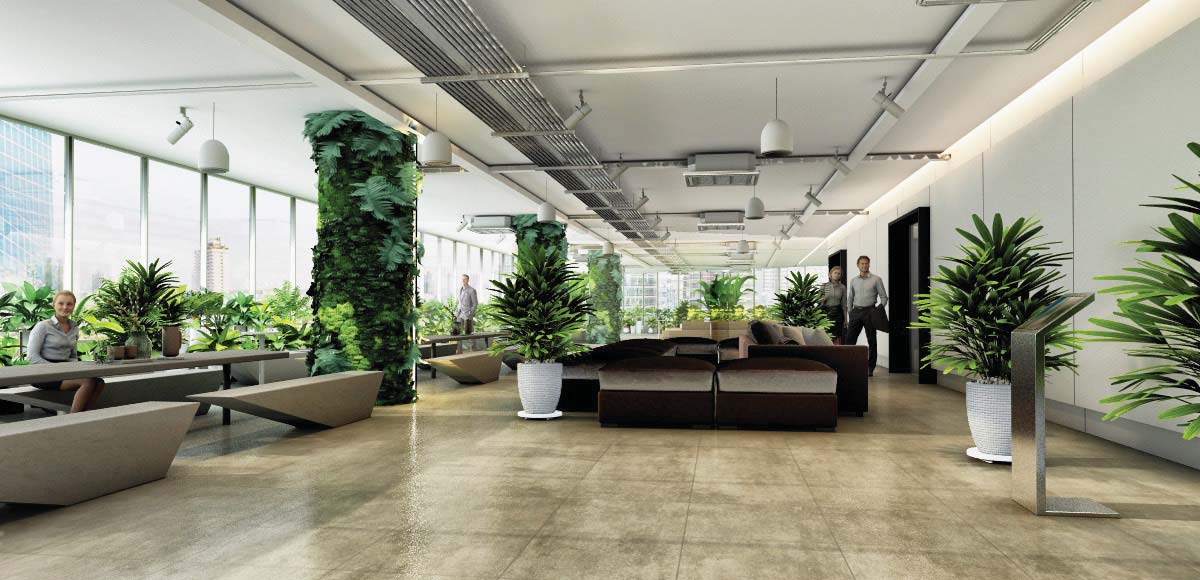
Semi-Outdoor Space, 5th Floor พื้นที่กึ่งกลางแจ้ง ชั้น 5The Council of Engineers Building features an open semi-outdoor area on the 5th floor — a space designated for semi-outdoor activities, relaxation, an indoor garden, and a dining area for members attending examinations or seminars at lunchtime. Dining in a semi-outdoor open space helps avoid the problems that typically arise from eating in air-conditioned spaces, such as odors, excess humidity, and waste.
However, to ensure comfort and usability in this space — which has no full air conditioning — supplementary systems are designed for the semi-outdoor area.
Around the plant pots and the living green wall (which uses real plants — no artificial plastic plants are used in this project), additional oxygen is generated. A DEHUMIDIFIED GREEN WALL moisture system is installed, using condensation on the chilled water pipe surface to collect water for irrigating the plants while simultaneously reducing humidity.
To improve air circulation and create a breeze for building users, ceiling fans are installed. Since the floor-to-ceiling height of this level is not very high, BLADELESS CEILING FANS are selected.
Despite these installed systems, there was concern about the heat during midday — especially during Thailand's hot season — which might make the space uncomfortable for full use. Therefore, the design also incorporates supplemental cool air supply: fresh air from the DOAS at approximately 24°C is routed through a cooling coil operating at 100% sensible heat only, so the air remains dry while being cooled. This cool dry air is distributed via UFAD (Underfloor Air Distribution) — floor-embedded diffusers positioned at seating locations to provide localized cooling for the space.
สำหรับอาคารที่ทำการสภาวิศวกร จะมีบริเวณชั้น 5 ที่จัดให้มีพื้นที่เปิดกึ่งกลางแจ้ง (SEMI OUTDOOR) พื้นใช้ในกิจกรรมกึ่งการแจ้ง ให้เป็นที่พักผ่อน กึ่งสวนในอาคาร และสามารถใช้เป็นที่จัดรับประทานอาหาร ในช่วงเที่ยงของสมาชิกที่เข้ามา สอบหรือสัมมนา การจัดทานอาคารในพื้นที่เปิดกึ่งกลางแจ้ง จะช่วยป้องกันปัญหาที่มักจะเกิดจากการทานอาคารในพื้นที่ปรับอากาศ ไม่ว่าจะเป็นเรื่องกลิ่น ความชื้นที่เกิด และขยะ ที่จะตามมา
แต่การใช้พื้นที่นี้ที่ไม่มีระบบปรับอากาศแบบเต็มรูปแบบ ให้ผู้ใช้งานมีความสบาย สามารถทำกิจกรรมได้จึงมีการออกแบบระบบเพื่อเติมในพื้นที่เปิดกึ่งกลางแจ้ง
บริเวณกระถาง ต้นไม้และผนังต้นไม้ที่ใช้ต้นไม้จริง (ในโครงการนี้จะไม่มีการใช้ต้นไม้พลาสติก) เป็นการเพิ่มออกซิเจนในบริเวณนั้น จะติดตั้ง ระบบความชื้นผนังต้นไม้ DEHUMIDIFIED GREEN WALL ใช้การกลั่นตัวของหยดน้ำในอากาศที่ผิวท่อน้ำเย็น เป็นน้ำสำหรับรดน้ำต้นไม้และช่วยลดความชื้น
เพิ่มการหมุนเวียน อากาศให้มีลมผ่านตัวผู้ใช้อาคาร โดยติดตั้งพัดลมเพดานแต่ เนื่องจากพื้นความสูงของชั้นนี้ไม่สูงมากนัก จึงเลือกใช้เป็น พัดลมเพดานแบบไร้ใบพัด BLADELESS CEILING FAN
แม้จะออกแบบติดอุปกรณ์ดังที่กล่าวมา ในความกังวลต่ออากาศร้อนในเวลาเที่ยงที่มีอุณหภูมิสูง โดยเฉพาะหน้าร้อนของประเทศไทย อาจจะไม่สามารถใช้พื้นที่ได้เต็มที่จึงออกแบบให้มีการจ่ายอากาศ เย็นโดยนำอากาศเย็นจากเครื่องเติมอากาศบริสุทธิ์ (Fresh air) ที่มีอุณหภูมิประมาณ 24–24 องศาเซลเซียส มาเพิ่มความเย็นผ่าน คอยล์เย็นที่ทำงานเฉพาะความร้อนสัมผัส 100% (100% sensible heat) เพื่อให้อากาศยังคงเป็นอากาศแห้ง แต่มีความเย็น โดยการจ่ายอากาศเย็น จะเป็นแบบ UFAD (Underfloor Air Distribution) หัวจ่ายแบบฝังพื้นจะจ่ายตามจุดนั่งพัก เพื่อสร้างความเย็นให้กับพื้นที่
igitalized Building Information (BIM)
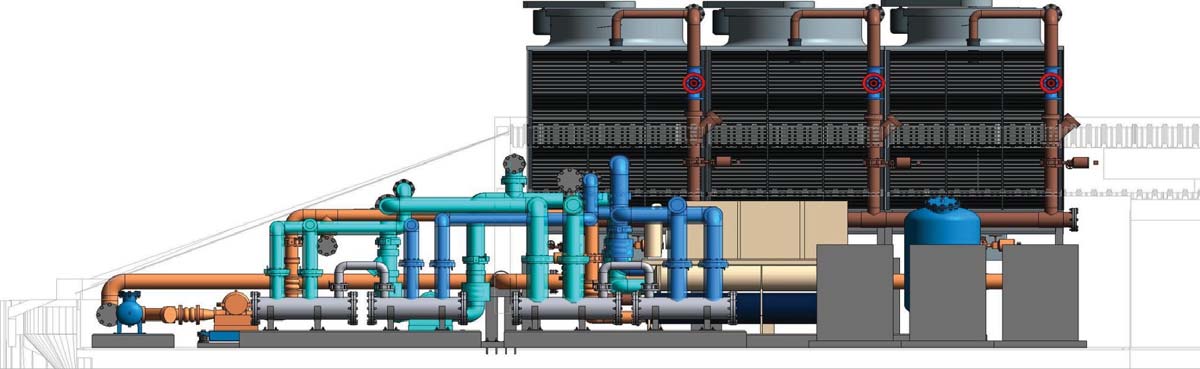
Building Information Modeling Technology เทคโนโลยี Building Information ModelingIn order to achieve maximum design efficiency and minimize inter-discipline conflicts, this project employed 3D virtual building model (BIM) technology to create a digital simulation of the building to assist in the design process. This was particularly important for the HVAC system's core component — the chiller plant room and cooling towers. The chiller plant room is located on floor 7.5, which is the sub-roof level of the building and features a sloping roof structure.
Using BIM (Building Information Modeling) technology allowed the team to identify constraints in each discipline from the very beginning of the design process, and to resolve those constraints through design modifications. For example, the structural roof framing above the chiller plant room — once the 3D models from each discipline were combined in the early design phase — revealed height conflicts. As a result, the structural framing was changed from a space-frame truss to a beam-and-column steel structure, to provide the required ceiling height for the chiller plant room at the critical locations.
เมื่อต้องการ การออกแบบให้มีประสิทธิภาพสูงสุด ลดความขัดแย้งของแบบ ในโครงการนี้จึงมีนำเทคโนโลยีการสร้างแบบจำลองเสมือนอาคาร 3 มิติมาใช้สร้างแบบจำลองขึ้นมาเพื่อช่วยในการออกแบบให้มีประสิทธิภาพ โดยเฉพาะในระบบปรับอากาศที่เป็นหัวใจคือ ห้องเครื่องทำน้ำเย็นและหอระบายความร้อน พื้นที่ห้องเครื่องทำน้ำเย็นอยู่บนชั้น 7.5 เป็นชั้นใต้หลังคาของอาคารที่ มีลักษณะของหลังคาเอียงลง
การใช้เทคโนโลยีสร้างแบบจำลองสามมิติหรือ BIM (Building Information Modeling) ทำให้ทราบถึงข้อจำกัดแต่ละส่วนงานในการออกแบบตั้งแต่เริ่มต้นของงาน และนำข้อจำกัดไปออกแบบแก้ไข เช่นโครงสร้างหลังคาอาคารเหนือห้องเครื่องทำน้ำเย็น เมื่อสร้างแบบจำลอง 3 มิติแต่ละส่วนงานมาประสานกันในช่วงแรกของการออกแบบพบปัญหาเรื่องระดับความสูง จึงมีการเปลี่ยน รูปแบบโครงสร้างจากโครงเหล็กถักเป็นแบบคานเหล็ก เพื่อสร้างความสูงให้กับห้องเครื่องทำน้ำเย็นในจุดที่ต้องการ
Once the full building model was completed across all disciplines, it was further used for material quantity take-offs, fire and smoke simulation, evacuation simulation, as construction drawings, and as a database for building maintenance going forward.
ซึ่งเมื่อดำเนินการสร้างแบบจำลองไปจนครบทุกส่วนของอาคาร ยังสามารถนำแบบจำลองไป ถอดปริมาณวัสดุการ จำลองการเกิดควันในอาคาร การจำลองการหนีไฟ ใช้เป็นแบบก่อสร้าง และเป็นฐานข้อมูลในการซ่อมบำรุงอาคารต่อไป
onclusion
Conclusion บทสรุปThe Council of Engineers office building can be considered a model building — one that is oriented toward the Well-Being of its occupants, promoting both physical and mental health and enhancing the productivity of those who work and visit within it. The design also considers minimizing resource consumption (Lean Resource Consumption). The design team hopes that the approach taken in the Council of Engineers office building will be of benefit to readers, in whatever measure.
อาคารสำนักงานสภาวิศวกรถือได้ว่าเป็นอาคารต้นแบบซึ่งมีทิศทางมุ่งไปยังความเป็น Well-Being ของผู้ใช้อาคาร ให้ผู้ใช้อาคารมีสุขภาพกายและใจที่ดีก่อให้เกิดผลิตผลของผลงาน (Productivity) รวมถึงได้คำนึงถึงการบริโภคทรัพยากรให้ต่ำที่สุด (Lean Resource Consumption) ทางผู้ออกแบบคณะผู้จัดทำหวังว่าแนวทางการออกแบบอาคารสำนักงานสภาวิศวกรจะประโยชน์กับผู้อ่านไม่มากก็น้อย
Meet the Team




Lat Phrao Road, Wang Thonglang Subdistrict, Wang Thonglang District, Bangkok 10310, Thailand
Tel: +66 86 577 8938 | info@next-2nd.com | www.next-2nd.com