Building Information Modeling (BIM) has become indispensable to modern MEP engineering. At Next 2nd Co., Ltd., we have adopted Autodesk Revit as our primary design platform for all projects since 2019, progressing from LOD 100 concept models through to LOD 350 construction-coordination models. This article documents our BIM implementation methodology — the BIM Execution Plan (BEP), Level of Development (LOD) standards, multi-discipline clash detection workflow, and real outcomes achieved on key projects including the Council of Engineers Thailand (COE) New Headquarters and Chulalongkorn Hospital renovation. The findings demonstrate that structured BIM implementation can eliminate the majority of field conflicts before construction begins, materially reducing RFI volumes, variation orders, and programme delay.
ntroduction
MEP systems — mechanical, electrical, and plumbing — are the most complex and spatially demanding elements within any building. Routing hundreds of duct runs, pipe lines, cable trays, and conduits through a constrained above-ceiling space while avoiding structural beams, architectural features, and the systems of other trades is a coordination challenge that traditional 2D drawings simply cannot solve effectively. Clashes discovered on site result in costly rework, programme delays, and strained relationships between contractors.
Building Information Modeling (BIM) addresses this challenge directly. By creating a precise, three-dimensional digital model of all building systems before a single element is installed on site, design teams can identify and resolve spatial conflicts — known as clashes — in the virtual environment, where changes cost time rather than money. Next 2nd Co., Ltd. recognised this potential early and made a company-wide commitment to full BIM implementation across all projects starting in 2019.
The transition from 2D CAD to full 3D BIM was not trivial. It required investment in software licenses, hardware, training, and — most critically — the development of a structured process to ensure consistent model quality across all projects and disciplines. This process is codified in our BIM Execution Plan (BEP), which defines roles, responsibilities, model standards, and coordination procedures for every engagement.
IM Execution Plan &
Level of Development
The BIM Execution Plan (BEP) is the foundational document for every BIM project we undertake. It defines the project-specific BIM goals, the software environment (Autodesk Revit as the authoring tool, Autodesk Navisworks for clash detection and 4D simulation), file naming conventions, model breakdown structure, and the schedule of model deliverables at each project stage.
Central to the BEP is the definition of Level of Development (LOD) at each design stage, following the BIMForum LOD Specification — the internationally recognised standard adopted from the American Institute of Architects and referenced in Thai engineering practice. LOD defines both the geometric precision and the attached non-graphic information (parameters) that each model element must contain.
| LOD | Stage | Geometry | Information | MEP Use |
|---|---|---|---|---|
| 100 | Conceptual | Overall massing, approximate size and location | System type, approximate loads | Feasibility studies, early-stage coordination |
| 200 | Schematic | Approximate geometry, size, shape, orientation | System capacities, equipment tag numbers | Schematic design, space allocation |
| 300 | Design Development | Accurate geometry — size, shape, quantity, location | Manufacturer data, performance specs, material grades | Full coordination drawings, tender package |
| 350 | Construction Coordination | LOD 300 + connections to adjacent elements, supports, hangers | Connection details, installation clearances | Clash detection, shop drawing approval |
| 400 | Fabrication | Complete fabrication-ready detail | Full procurement data, serial numbers | Prefabrication, as-built |
For most projects, Next 2nd delivers MEP models to LOD 300 as part of the design package and advances to LOD 350 during the construction coordination phase — the stage at which all trades model their systems in sufficient detail to allow meaningful clash detection and resolution. Models are shared in real-time through Autodesk Construction Cloud (formerly BIM 360), giving project owners, architects, structural engineers, and contractors simultaneous access to the latest coordinated model.
lash Detection &
Coordination Workflow
Clash detection is the process of automatically identifying spatial conflicts between elements of different systems or disciplines within a federated BIM model. At Next 2nd, we use Autodesk Navisworks to combine discipline-specific Revit models (MEP, structural, architectural) into a single federated model and run systematic clash tests. We classify clashes into three categories:
Hard Clash
Two or more elements physically overlap in 3D space. Example: an HVAC duct penetrating a structural beam flange. The most critical type — physically impossible to build as-modelled.
Soft Clash
Elements do not touch but violate a required clearance zone. Example: a pipe within 50mm of a structural column — technically clear but impractical for maintenance access.
Time-Liner Clash
A 4D sequence conflict where an element is scheduled for installation before the space it occupies is physically accessible, or where two trades need the same space simultaneously.
Our coordination workflow follows a weekly cycle during the construction coordination phase. Each discipline updates their Revit model and uploads to Autodesk Construction Cloud. The clash detection run is then executed in Navisworks, producing a clash report sorted by priority. The BIM Manager distributes the report to responsible discipline engineers, who resolve each clash in their authoring model and re-upload. The process iterates until the model achieves zero hard clashes and all soft clashes are reviewed and accepted or resolved.
This weekly cadence creates a feedback loop that progressively tightens the coordination, typically resolving 80% of hard clashes within the first two rounds and achieving a fully coordinated model within four to six weeks for a typical medium-complexity project.
Key principle: Every clash resolved in the virtual model saves approximately 10× the equivalent rework cost on site. For a medium-scale project with 200 clashes resolved pre-construction, this represents a cost avoidance that typically exceeds the entire BIM coordination fee.
roject Experience
The following case studies illustrate the practical application of our BIM methodology on two projects of distinct character: a new-build prestige office building and a complex renovation within an active hospital environment.
Case Study 1 — Council of Engineers Thailand (COE) New Headquarters
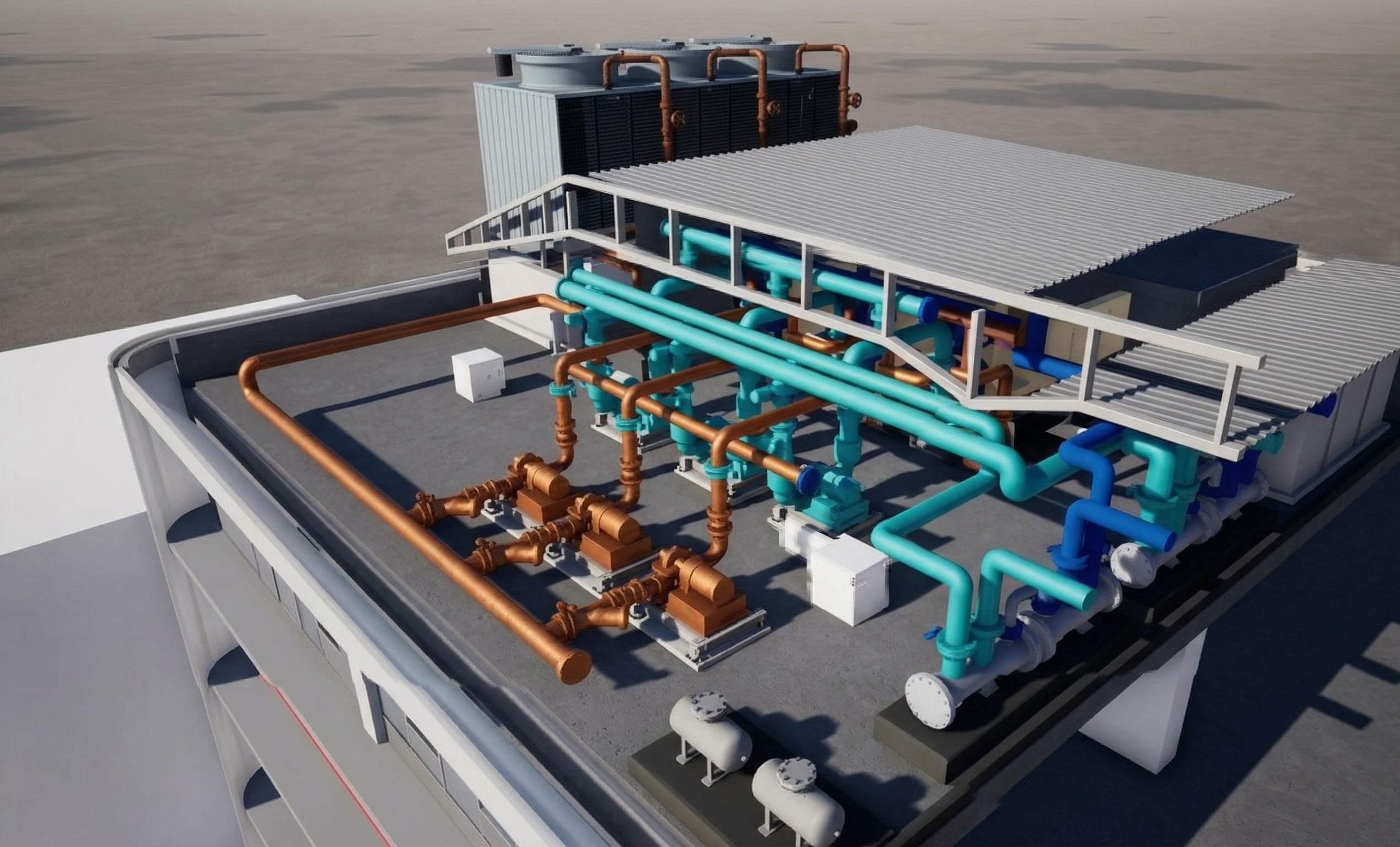
The COE New Headquarters is a 7-storey, 9,000 sqm office building on Ladprao Road, Bangkok, designed to showcase Thailand's engineering excellence. For Next 2nd, it represented the most comprehensive BIM implementation to date. The entire MEP scope — HVAC, plumbing, fire protection, electrical, and data/communications — was modelled to LOD 350 in Autodesk Revit. The model was coordinated against the structural frame (including complex transfer beams) and the architectural fit-out in Navisworks.
The clash detection process identified and resolved 312 hard clashes and 87 soft clashes prior to the start of construction. The most common conflict types were HVAC ductwork vs. structural beams (41%), MEP service crossings in corridor ceilings (28%), and electrical tray vs. plumbing pipe clearances (19%). Zero field clashes were reported for the MEP work after construction began — a result that the main contractor credited as a significant factor in the project completing on schedule.
The COE building subsequently received the Council of Engineers Building of the Year Award 2022, with the BIM coordination quality specifically cited in the award documentation as a benchmark for future Thai engineering projects.
Case Study 2 — Chulalongkorn Hospital Renovation
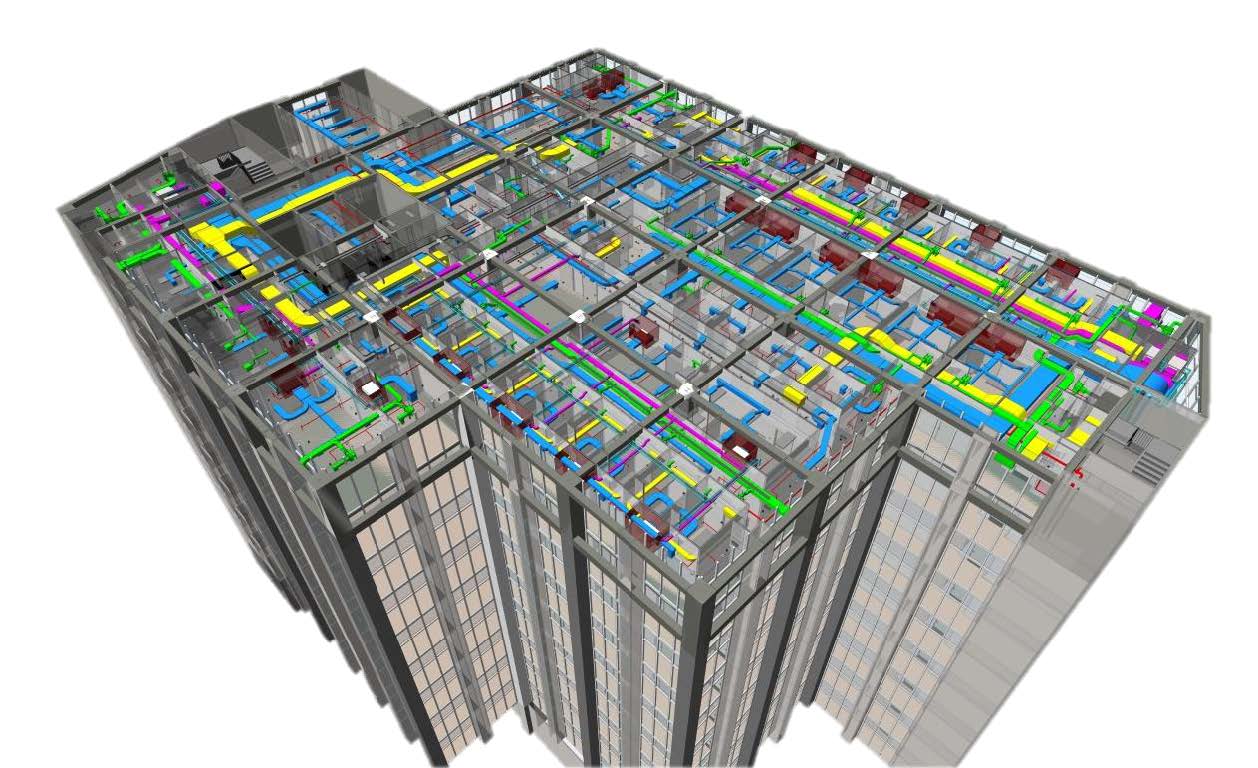
Hospital renovations present unique BIM challenges: the existing building was constructed before BIM was practiced, meaning no digital model existed; the renovation must be coordinated with all the complex MEP requirements of a healthcare facility (infection control, medical gas systems, redundant power, pressurisation cascades); and critically, the hospital must remain operational throughout construction.
For the Chulalongkorn Hospital renovation project, we began by conducting a 3D laser scan survey of the as-built conditions and translating the point cloud data into a Revit as-built model. This gave us an accurate representation of the existing MEP systems — much of which had been installed incrementally over decades and was not accurately reflected in the 2D drawings on record. The proposed new systems were then modelled on top of this as-built base and coordinated using the standard Navisworks clash detection workflow.
The as-built modelling process revealed numerous undocumented services — existing conduits, drain lines, and ductwork that were not shown on any available drawing. Had these not been captured in the BIM model prior to design, they would almost certainly have resulted in expensive design changes and installation rework during construction. The BIM-first approach allowed us to design the new systems around the actual existing conditions rather than the outdated record drawings.
enefits & Measurable
Outcomes
Across our BIM project portfolio, we have observed consistent, measurable outcomes that justify the additional investment in BIM coordination. The benefits manifest at multiple stages of the project lifecycle — from design development through to construction and handover.
RFI Reduction
BIM-coordinated projects typically generate 60–75% fewer MEP-related Requests for Information (RFIs) during construction compared to 2D-only projects of equivalent scope.
Programme Savings
Eliminating field rework associated with clashes removes one of the primary causes of programme delay. Our projects show MEP installation progressing 15–25% faster on BIM-coordinated schemes.
Cost Avoidance
Industry research (NIBS, 2007) and our own project data indicate that every ฿1 spent on pre-construction BIM coordination avoids an average of ฿5–10 in field rework cost.
Owner Benefits
The BIM model serves as the foundation for facility management after handover — embedding equipment data, maintenance schedules, and warranty information that support the building's operational life.
onclusion
Building Information Modeling has fundamentally changed what is possible in MEP engineering. What was once an aspiration — designing complex building systems with virtual certainty that they will fit together and perform as intended before a single piece of equipment is installed — is now achievable, routine practice for teams that have made the structural commitment to the platform and process.
At Next 2nd Co., Ltd., our full BIM adoption since 2019 has delivered consistent results: fewer field conflicts, faster installation programmes, reduced RFIs, and higher client satisfaction. The Council of Engineers Thailand project — recognised as Building of the Year 2022 — stands as the clearest evidence of what disciplined BIM implementation can achieve at the highest level of Thai engineering practice. We continue to deepen our BIM capabilities, expand our use of Autodesk Construction Cloud for real-time collaboration, and push toward LOD 400 fabrication models as a standard deliverable for appropriate project types.